Mother Song II
Solo exhibition Wineke Gartz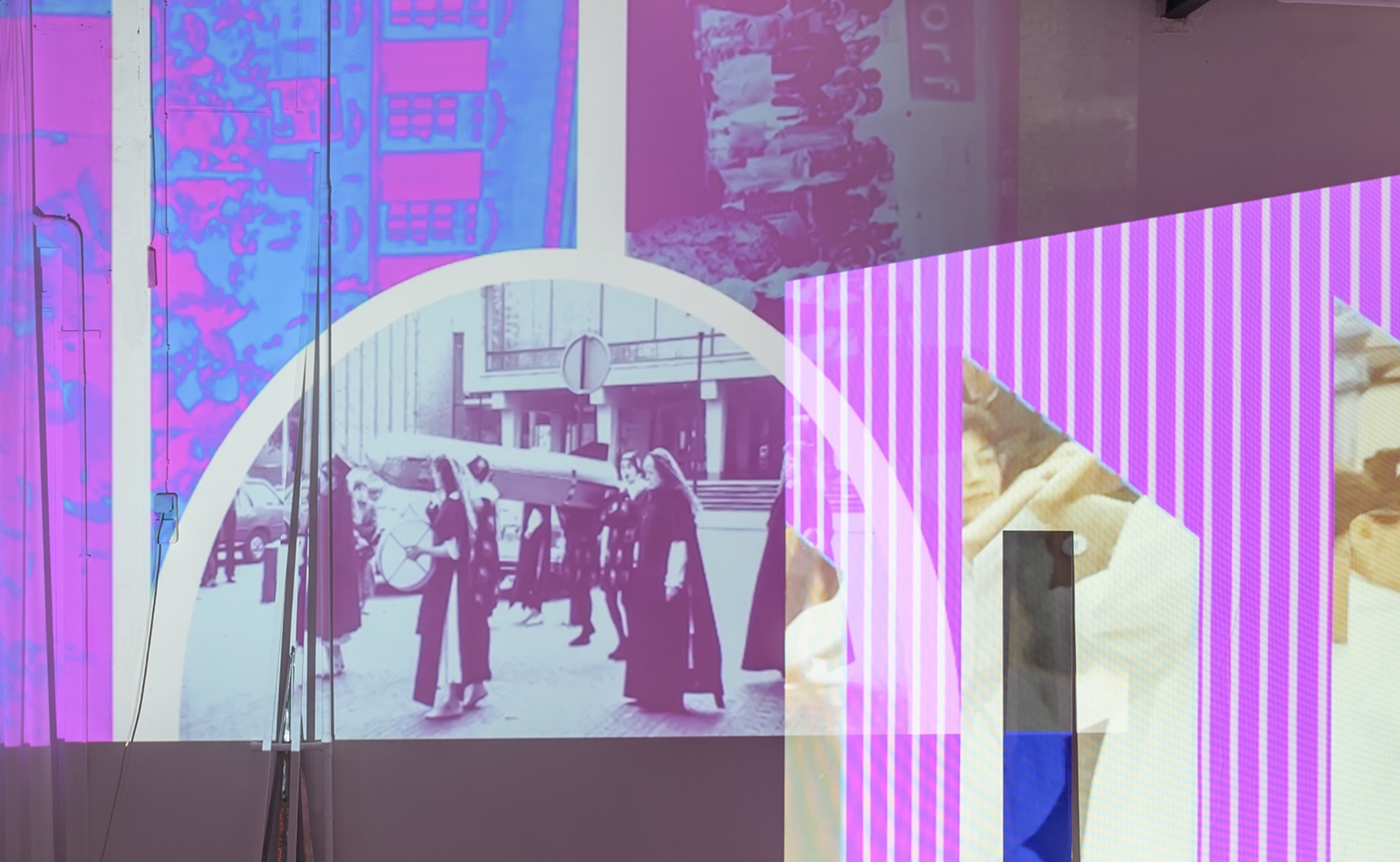
multimediainstallation
Two weeks extended, up until November 1st 2026!
From June 12, Fotomuseum Hilversum presents Mother Song II, a new site-specific installation by Dutch artist Wineke Gartz (Eindhoven, 1968). For the exhibition, Gartz worked on location at the museum for a month on an immersive multimedia installation in which video projections, photography, sound, textiles, and architectural elements come together. Mother Song II is a spiritual work about action, silence, and movement. It revolves around activism, but above all about the inner conflicts people experience in times of war and resistance.
In Mother Song II, Gartz connects her fascination with activism with her interest in hypnosis, rhythm, and the healing power of art. Everything in the space is aimed at intensifying the visitors' perception and evoking a meditative state within them. The work builds upon Mother Song I (2022), which originated from the personal archive of Gartz’s parents, filled with protest photos, magazines, leaflets, and video clips. For Mother Song II, the artist combines this archive with images of recent protests she attended herself, including the Feminist March in Amsterdam. Historical protest images also play a role in the work, such as those from Pentagram Day on May 13, 1986, organized by Women for Peace. Women for Peace was a protest movement against nuclear weapons, for peace, a cleaner earth, equality for women, and marginalized groups. Gartz’s mother was part of this group of women.
By bringing together archival material, new images, abstract forms, objects, and sound, Gartz makes the energy of protest palpable once again in the present. Movement and stillness, love and pain, darkness and light come together in an installation that invites visitors not only to look, but also to experience the work physically and emotionally.
The soundtrack of rousing drumbeats, interspersed with moments of deep silence, was composed especially for Mother Song by Dirk Bruinsma. For Mother Song II, the artist has added sound fragments of protest songs and birdsong to it.
About Wineke Gartz
Wineke Gartz (1968) lives and works in Amsterdam. She studied at the Academie voor Beeldende Vorming in Tilburg, subsequently completed the 2nd Phase of Fine Arts program at St. Joost, and was a resident at the Rijksakademie van beeldende kunsten from 1997 to 1999.
Gartz works in a multidisciplinary manner, incorporating video, photography, drawings, collage, sound, and installation, among other media. Her background as a painter remains visible in her attention to color, composition, and space. In her work, she explores the relationship between image, body, and consciousness. Her installations emerge from a combination of intuitive and analytical processes, in which images, materials, and space constantly form new connections with one another. In doing so, she often compares the creation of installations to composing music or moving through a landscape.
Her work has been exhibited at Schloss Biesdorf in Berlin (2025), Club Solo in Breda (2022), and the Kröller-Müller Museum (2019), among others. In 2019, commissioned by the Royal Dutch Mint, she designed the commemorative coin for Jaap Eden.